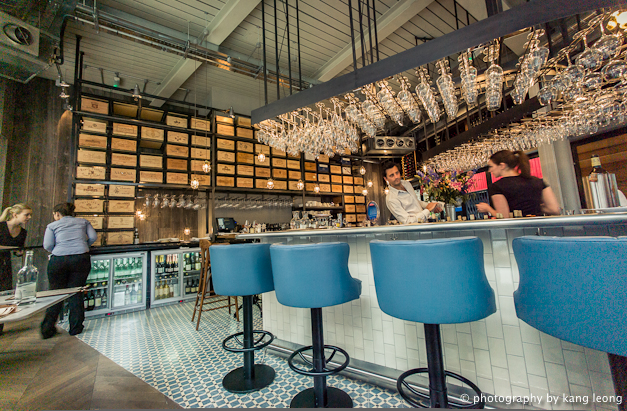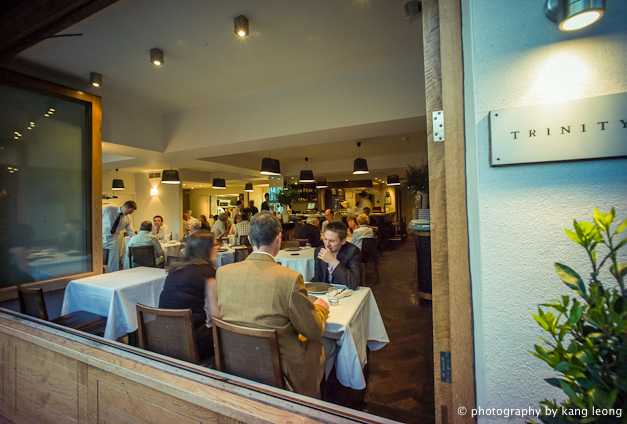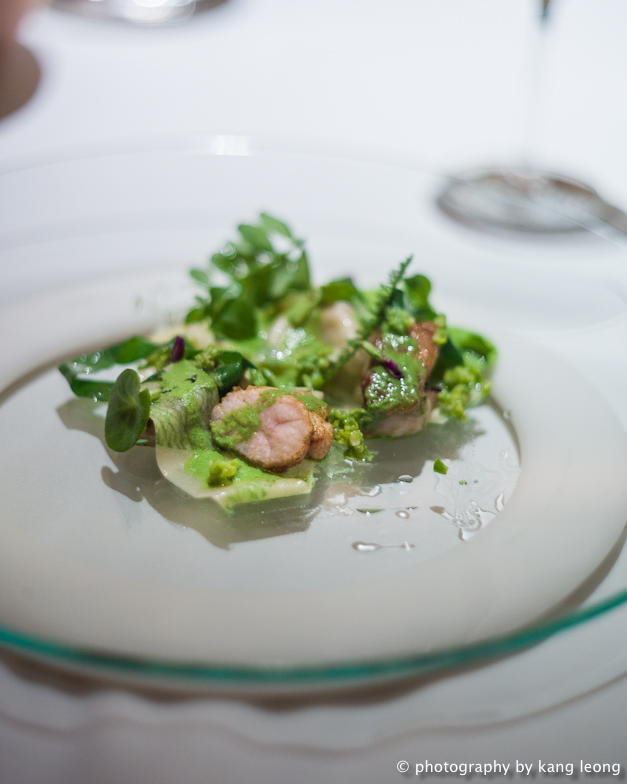
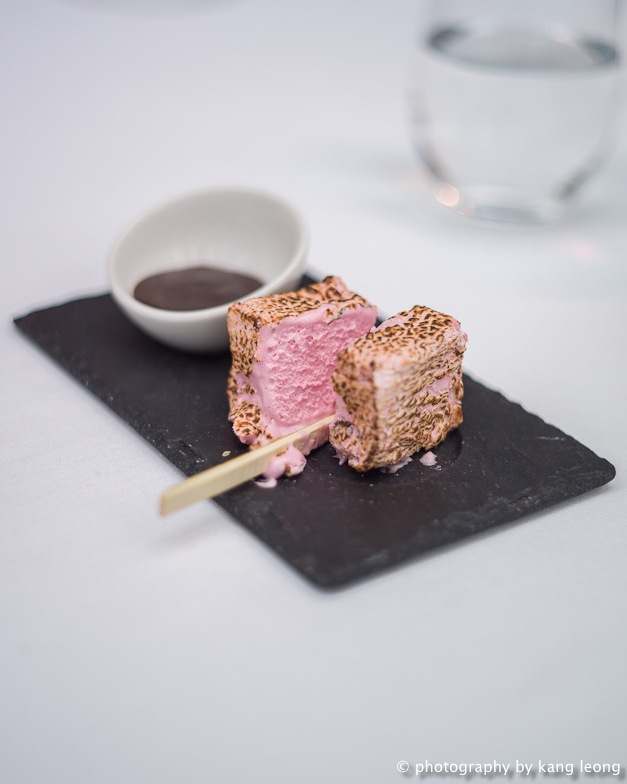
“..surrounded by the greatest wines of the world..” The dining room is relatively small but is as intimidatingly as it is posh, as the website’s official photographs suggest. Built around the ‘wine salon’, the restaurant’s private room takes up to 8 people and is encased by temperature-controlled glass walls filled with some of the sommelier’s (Alex Gilbert) most prized bottles. All completely out of my spend range for this solo Friday lunch (or any meal for that matter). Indeed, all of the world’s most storied labels grace Alyn Williams’ wine list, and I feel it only apt to dedicate the following paragraph to this exceptionally procured cellar: All the 1st growth clarets feature, from average to exceptional years, including a ’90 Lafite. Beyond the formidable Pauillac region, an ’85 Haut-Brion (the sole non-pauillac 1st growth) is listed with a centurion ’82 vintage of La Mission as the proud emissaries of the great wines of Graves – arguably the most romantic of all Bordeaux wines. Cos, Palmer, Petrus represent St Estephe, Margaux and Pomerol. Glaring omissions may be the popular Pontet, the age-worthy monster Montrose and Graves underdog Chevalier Rouge, all three producing consistently fabulous wines in recent years. Personally, I was drawn to the millennium Figeac, the 2nd tier GCC from St Emillion …for £400, easily a 3x mark-up (Liv-Ex trading at £90-110/bottle in bond prices) and only just within
No doubt you’ve already heard about Ceviche, the first of a trio of Peruvian restaurants to open in London this year. Started by Martin Morales, Brit with half a Peruvian heritage, he gave up a notable music career (According to Xanthe, he signed KT Tursntall and launched iTunes in Europe!) to plug a gaping hole in the market. Which he reckons will be nicely filled with an introduction to raw seafood cold cooked in tiger’s milk. Apart from the fusion dishes at Nobu, I’ve never eaten Peruvian food. This cuisine has always been written about as the next big thing (Monocle did a nice spread last year), partly given its unique history of diverse cultural influences, one can argue that Peruvian is a true expression of fusion food. Given the decades the Nobu restaurants have spent in the (international) limelight , Peru hasn’t really taken off as a must visit destination for gastro-tourist. The cuisine’s foremost ambassador is Gastón Acurio. By wikipedia’s account, he is a bit of a legend in his native Peru. His name is attached to No.35 on the 2012 World Best 50 , but it diffuses down to a diverse portfolio of operations which include a hamburger bar, a Peruvian-Chinese restaurant, a hotel and even a ‘gastronomic’ university. I’m most intrigued by the mention of his roast chicken franchise, La Pollada. Might it come on British
I have asserted in the past that Bryn Williams is the most underrated chef in Britain, and that I’ve wanted to return to his restaurant, Odette’s to delve deeper in his cooking, beyond the GBM dish that sent his career into overdrive. Perhaps it is because his restaurant is in a tucked away location (in Primrose Hill) , and that it’s a little old fashion which is probably why it doesn’t receive the same kind of attention which centrally located counterparts may enjoy. Odette’s has also been in the same spot since ’78, albeit changing ownership many times over the years, before Vince Power took over the reigns in 2006 and lured the young chef away from the clutches of the Galvin Brothers. Bryn has since bought the restaurant out, and has been Chef Patron since late 2008. If those walls could speak. I just think there such romance to Odette’s. You can’t beat heritage (no matter how patchy) and I think history is embodies the ideals of a neighbourhood restaurant. Food is part skill, but also part nostalgia. White bread, ketchup and bashed fillet steak with black pepper might not be ‘gourmet’ but the smell of pan-fried steak always takes me back to my childhood Sunday lunches. The ambiance (and by extension the leafy neighbourhood locale of sleepy cafes & pet shops) is cocooned and cosy but most of
Rob & David’s eponymous restaurant has only just toasted its ten year anniversary. A decade and a bit, largely recognised as one of a handful of institutions of Iberian cooking in the business. Not forgetting the Eyre Brother’s first effort, The Eagle, which has already entered the annals of culinary legend. It predates the rise of the Brindisas and – in certain respects – is seen to have nurtured its growth. After all, Jose Pizarro did spend his first years in London with this fine establishment. The restaurant celebrates cooking from the Iberian peninsula, with the roots established in Portuguese cooking. Perhaps due in no small part to David’s upbringing in Mozambique, a former Portuguese colony. Today, there are many luminous representatives of Iberian cooking in the city, dare I say, that Spanish cooking has hit a high level of consistency. Whatever formula that may be applied to running successful Spanish restaurants which appeal to Londoners, has been perfected. Copita, Salt Yard, Jose/Pizarro and even the post-Pizarro Brindisas just to name a few of the current crop of small plate leaders all produce lovely food. Progress is inevitable, but I believe there’s always a sense of romance when visiting restaurants with a bit of history. The Alpine cabin ambiance does remind me a little of Pizarro – Slick yet down to earth, with a long bar which entertains a more
I have resisted Roti Chai for several months now, it’s right opposite Selfridges, conveniently located, if you shop on Oxford Street often. I think the interior design does it no favours. The colourful theatre-land of over-sized repros of food brands (meant to evoke nostalgia I’m guessing) gives the impression that this a prototype for a upcoming franchise. Then I had dinner with a few weeks earlier with the venerable former food blogger Helen WFG and her hubby the enigmatically blurry Garson Byer who both gushed about the fantastic happenings in the kitchens of Roti Chai. Fantastic and a little bombastic. Reviews and word of mouth suggest a thriving returning clientele because of its supposed authenticity and obvious quality cooking. The restaurant is split into two discreet operations under the same roof: Upstairs aka The Street Kichen; a lighter, faster and presumably cheaper menu is available and open all day. Down in the basement dubbed The Dining Room, the interiors are somewhere in between a lounge bar and Bob Bob Ricard, with marble replaced by wooden floors. Less finger food, more elaborate sounding dishes from the regions and is only open for dinner. Two kitchens, two head chefs, two restaurants in one. I visited for a Saturday lunch, and obviously ate upstairs. The missus opted for a virgin cocktail and I drank Mongoose lager for the very first time. Certainly extra
“The change is more than skin-deep” – First words you’ll read on the newly revamped Tom Aikens website. Words from a chef (or franchise I should say) who seeks a fresh break from his past. One which has always had a question mark hanging over it. From his accidental searing of a sous chef with a hot knife to the more recent financial woes which involving the way he had gone into administration, and the fate of the debt owed to small scale (presumably angry) suppliers using a pre-pack administration / phoenix insolvency process. Effectively this allowed him to carry on business as usual, free of debt but burdened with a slightly sullied reputation. On the other hand, Aikens was one of Koffman’s original group of proteges (and then installed as head chef) when Le Tante Claire won 3 stars, and he was one of the youngest chefs in his day to gain (retain) 2 ** during his time as head chef at Pied de Terre. It is undeniable that he has real talent in cooking, invariably met with universal praise. In late 2011, his eponymous restaurant closed for refurb, reopening earlier this year with a new outlook on (what appears) all fronts. In the process, Tom had lost his star, which probably might be a good thing for this reputation rebuilding campaign. For all the time he’s been cooking
I am too tender in age to have lived through the days when Conran restaurants were the pride of the industry. Those glory days are no more than urban legend as told by the doyens amongst food writers… some of whom have exhausted equal column inches in slagging off the same restaurants dreamed up by the original Design Entrepreneur. I’ve wanted to write about the radio initiative of Tyler Brule’s pioneering (and my favourite) print magazine, Monocle 24 for some time now. I love it so much; it has become an integral part of my gym routine. There are 12 radio shows, my favourites are The Menu, The Entrepreneurs and Section D. In this particular winter special, Section D managed an interview with Sir Terrance, who spoke about his Habitat days as well as his career high in striking a tie-up with M&S. It meant he got to sell his furniture to the masses, as opposed to being niche. Or to paraphrase – how distribution of his designs were democratised. Alongside his entrepreneurial adventures in home furnishings, Conran’s expansive brasserie empire grew to include The Orrery, Bluebird, Coq d’Argent, Pont de la Tour as well as Bibendum at the Michelin House in Chelsea. Eventually he sold up to the D&D group which now operates this group of restaurants. The owners Des Gunewardena and David Loewi are both ex-Conran. Conran’s legacy
Sometimes, it seems like all I eat these days are burgers. Ohh.. that yellow, is that *gasp* american cheese? Hah. Yeah it looks great doesn’t it? 8oz Cheeseburger with Chips, £15. It looks dangerously risky for a medium rare, which is to say, it satisfied expectations for those of us who like burgers to be bloody. I don’t really want to open up another debate on this issue, but personally I feel that a rarer patty has better texture, juicier (or less dry I should say) and has better flavour than something more cooked. This is indeed a pretty good burger. Actually, it’s better than good, it’s probably one of the best burgers in town (yes I know, every other burger place seems to be somebody’s ‘the best’ these days). Pople, Young, Burgerac and Bellaphon have roundly praised the burger, and after this visit, I can only echo their opinion. Those guys really do tell a more eloquent story about the technicalities of why this patty is so good, but for what its worth, I think the resultant product is quite special. On Burgerac, Fred Smith explains that his patty is ‘blended’ from 50% rib cap, 25% chuck and 25% of trimmed fat plus some other little bits. The beef are supplied by Darragh O’Shea , cuts are dry-aged in house prior to mincing. The impression I get is that
Well, I finally made it to this Honest Burgers. There was a bit of a wait to get our table – 45 minutes – for a late lunch at 3pm on a Saturday. We were a table of five, we didn’t have to queue physically, as they took down my mobile and called up to let us know it was our table was ready. As you have probably read elsewhere, they’ve received much publicity last year, and is generally held in high regard by the burger lovers. As high regard as the Meatwagon & Lucky Chip burgers. On the same token, there are those who have written about an inconsistent experience. The Cheese, with house chips with rosemary salt, £7.50. That’s a neat brioche. The patty looked wet & juicy, the cheddar only just melted over it. The red onion relish is the unique condiment which sets the honest burger apart from its competition. The smell of rosemary filled our table, so much so, I could hardly detect grilled beef – a change in the usual burger outing. Like most democratic burger restaurants these days, food is served in wartime enamel crockery. I did some digging around, and found Falcon enamelware which has been trading since the 20s. Our immediate reaction were that these burgers looked a little small. More like oversized sliders. In fact, they looked about the same
I was rather surprised when I arrived to an empty restaurant. This restaurant (barely 2 weeks old as of writing) has been trending on twitter thanks in part to the double whammy four star reviews courtesy of Fay and Guy. Two of the doyens of London restaurant writing. The peace and quiet didn’t last long, as soon as the clock hit 1pm, droves of people came flooding in. As it was a Friday afternoon, I assumed mostly it were you folks who work close enough to have swift work lunches in Soho. The chef/co-owner is one Cameron Emirali, ex-Wapping Project, an old power station converted into art gallery – its messhall which I have yet to visit, consider the quality of museum/gallery cafes these days. (More on this toward the end). Wine is suppose to be a highlight, as the other co-owner is Luke Wilson who manages front of house is a bit of a wine-head. I drank a glass of the Hinrich, An Austrian red made using Blaufränkisch grapes for £4. Unbeatable value considering the pedigree, but I found it to be a little flat and bitter for my tastes. You know I’m really a Beaujoulais/Spätburgunder kind of guy these days, acid & jam is the flavour of the moment for me. That’s a self-deprecating joke, which is to say that my taste in wine is currently piss poor
… I write to you as I lie on the blackened brown beach in Brunei. It overlooks the oil rigs just off the coast that fuels the economy of this tiny Sultanate on the Northeast coast of Borneo Island, and behind me, my parents’ backyard. Happy new year LDN. I am technically still on my xmas vacation which is just spilling over into the new year. Did I mention the equatorial climate mean that it’s a sunny 30C every day? What better way to break the 2012 bubble than to recount a November 2011 visit at a true London institution and a destination restaurant. Yup after nearly four years of hot air, I finally made it to Chez Bruce in Wandsworth. In my often narrow and simplistic view of the shadowy powers which have molded our idea of the template for london posh dining, I see two power players whose influence reaches across an association of restaurants. Glorious chefs have passed through these kitchens at some point in their career, and in a way, these breeding grounds are the bedrock for the progression of high cooking. On one end of the stick, we have zen master Phil Howard with his double-macarooned lair – The Square. This is of course a story that is written to death about, since Brett Graham trained with Phil in the beginning days before they spun
This is the only time you’ll see the food menu, because these three items are quite literally all they serve. After Hawksmoor successfully ported the America’s favourite summer roll to the El Smoky last year, it was only a matter of time before the Russians would follow. Well it took them a while, but the good people from Goodman (who are imho still the capital’s best steakhouse(s)) bring you the first lobster bar in London. With burgers. And cocktails, designed by The Soul Shakers. If Goodman attracts the mid-week fat banker stereotype (actually, I think they entertain more Chinese tourists rocking bling Vertus than city workers) , then Burger & Lobster is where the fat banker would take his family for a weekend meal. If I was 10, I could totally see myself bibbing up every Sunday with my family at this restaurant. No really, I love this place, it’s basically premium fast food. So, you choose either a Beef burger, a lobster roll or a steamed/grilled whole Canadian lobster for £20. Every plate comes with chips, salad, clarified butter (with or without lemon) with the seafood and in-house pickles for the beef. Grilled Lobster, chips, salad, £20. When you visit, ask Dave Strauss (if he’s about) to show you the lobster tanks which they have specially put together in the basement to hold … tonnes of live, swimming critters
At last, José Pizarro’s diptych is finally complete, and you know what, it’s mighty fine work. The restaurant took a while to finish – it’s at least a month late, and the private rooms are still awaiting the finishing details – but it finally opened, and my my, is it going to be a smashing success in 2012. It seems to be fashionable these days for Spanish restaurant owners to pair larger scale restaurants for the full experience with a more modest – or shall we say more fun – sherry bar for the easy tapas and alhambras. If you cast your mind back to the boozy summer of sherry and half cooked pork, you’ll remember that José really was just the prologue to something much bigger to come. And it is much, much bigger. If José was a cute baby taking his first steps into the dangerous world of hospitality, then Pizarro is all grown up 28 year old voluptuous Paz Vega all lips, puppy dog eyes and husky voice (Oh Paz Vega, wouldn’t that be a christmas to remember). Alright to be fair then, how about a 35 year old Antonio Banderas with his piercing stare, a Spanish guitar with brand new nylon strings and cat whiskers. For background noise, the front of house chose Nina Simone tracks from (I’d like to think it was) her 1958 album
AKA …where Kang spent most of his moolah this year. The time has come to reflect on what’s been yet another crazy year of restaurant collecting. Just when I thought the burgeoning number of openings in 2010 were overwhelming, 2011 came and smashed 2010 out of the park. There was literally something new to try every week. There’s more diversity than ever from this year’s round of openings and non-openings with ‘street food’ coming of age and the no booking policy becoming the norm. I think eating out is still expected to be a special occasion, but now it’s done more regularly, more spontaneously with less formality and with costs spread out across more meals. With that, I think it’s fair to say that 2011 is the year that ‘fine dining’ died and came back to life as a caricature of itself. This was epitomised with the baffling 2nd update to the Bib in the fall (or I should say, releasing 2012′s revision six months ahead of schedule). It has only done damage to the credibility of their vaunted macaroons. Looking at what’s coming in the pipeline, 2012 looks to only build on the momentum of 2011. At this rate, one wonders if there will be a point where we will hit critical mass. Maybe shitty restaurants will become extinct, someday, who knows. I think its safe to say that
Who comes up with all this fiction just for a restaurant? This is the persuasive language Oliver’s people have generated for his latest project: “Ours is a union of ideas, traditions, and of people.” “Where wood-fired flatbreads meet great British flavours.” Lookintomyeyeslookintomyeyes. What’s with the wonky name – why not just call it Union or Union Jack. Is this meant to be ironic? I don’t get it. The ambiguity with the plural form (or misplaced punctuation) is the restaurant equivalent of the 2012 Olympics logo. In spite of the spin, this really is just a pizzeria. It’s billed as some kind of ground breaking bastardisation of the humble Italian pie, by the hand of Jamie’s very Bri’ish style and nicknamed as Flatbreads. As if one could reinvent something simply by calling it something else. I do like the ‘Gary Baldy’ biscuit, however. I’d like to think these concepts were the result of a complicated brain storming session by a think tank of consultants locked in a meeting room and eating nothing but pizza to precipitate ideas. Back in the real world, this union is a partnership between Jamie Oliver and Pizza Maestro Chris Bianco. This Central St Giles location being the pilot for a upcoming franchise, which (presumably) pending the success of this branch, will spread throughout London and the rest of the country in the next couple of years
My food writing invariably boils down to a caricature of self-indulgent cliched hyperbole or superflous self-doubting and pointless debate of what food should taste like. Given the circumstances, I sincerely believe this is the best thing between buns I’d yet come across. But first let us be properly acquainted. Reader meet Lucky Chip’s weekly burger special “The Bill Murray Life Aquatic Surf and Turf”. She is an aged beef patty with a (new) sesame bun, partnered with a fried soft-shell crab, guac, spring onion, spicy mayo, sweet chilli ginger sauce and processed cheese. She’s worth £9. Yes, I thought so too, how could purists ever love such a criminally tainted patty which has laid with a creature from the deep blue sea? After one bite, any lingering doubt was erased. I was completely convince: this wasn’t just a great burger, this was a sexual experience. As you know, Lucky Chip, like Meatwagon, utilise the steam-the-patty-and-fixing under a metal cloche technique, which allows all the flavour-concentrated steam to re-condense within the patty, leading to the satisfying and sloppy mouthful. However, I was most impressed with how the guac, the syrupy sweet chilli drizzle and soft shell crab complimented the already potent beefiness of the patty. The burger had this great textural quality that held together real well, a little like the way it feels when you sink your fingers into kneading
Damn it, he’s done it again. (He being the elusive blurryman with the fire red scarf, and thick brown rim specs, aka Mr Cool.) And here I thought that Da Polpo was the last cherry atop this tiny empire. They are back, this time around, Norman, Beatty and Oldroyd give us a glimpse of something a little Jewish. It’s deja vu because Mishkin’s is like that other off-shoot hobbyist lightbulb moment which Russell Norman had brought to life. Remember that ..the truffle egg toast, the ground beef sliders, the speak-easy-esque ambiance? You know how much I love Spuntino, I was so excited with this project, I decided to book a table on the first official day of service. 50% off for the previews. As usual, Russell is on scene for day one service (yeah… I’m pretty sure I was there for first day service at DaP and Spun as well) to greet us. So new, the paint is still drying, but this time around, things sure look much tidier. The decor possess the now classic Norman touches : there’s the rectangular bar, the Victorian ceilings, dangling lamps, the brick walls. It’s like an American diner but all grown up, bringing some Madmen slickness to the indie feel. Its Spuntino in a red blazer with beige docker trousers and polished brogues. Floors are decked out with black and white tiles, the
Here’s a list of good things I expect from a good bistro: 1.Good soup 2.Good steak 3.Good frites 4.Good tartare 5.Superhot waitress I recall a highlight reel of what the Glasgow arm of this luxury out-of-town hotelier is capable of, during an episode of Don’t tell the bride. They took the tour through the banquet room, the room for the exchange of vows, the grounds. the venue was so slick, the bride cried knowing her man would never plan their wedding there. Of course, I don’t watch that show. It just happened to be playing in the background as I was shaping my manly deltoids at the gym. Obviously. There are fifteen Hotel du Vins up and down the country from St Andrews to Brighton, none are in London, but presumably all of the hotel restaurants resemble some version of bistro du vin. As of writing, there are two Bistro du Vins in London; one is next to the shit-hot Duck Soup Soho, and the other currently occupies the site where one of the best London bistros died – Bjorn van de Horst’s Eastside Inn. You do remember Eastside Inn don’t you? That was nice French food. Bistro du Vin doesn’t punch at that level, but in many ways that’s a good thing, because really the formulae that’s being applied – competitively priced, traditional French bistro affair, enomatic-preserved wines by
Bryn Williams is the most underrated chef in this country. I recall his stupendous turn on the first season of Great British Menu, in which his representation of Wales on a plate of cockles, samphire and turbot, eventually won its way to HM’s 80th birthday bash. Something I’m sure she gobbled up with glee. Five years on, the same dish is now a famously permanent fixture from his ALC menu at Odette’s. I had it last year and I was completely flabbergasted by how good the conception of the dish really is. It remains one of the most memorable dishes Ive ever eaten, and that sentiment also extends to the rest of Bryn’s fantastic cooking. I continue to be amazed by the lack of internet champions for this terrific neighbourhood restaurant. Maybe that’s the problem, that Odette’s is so well nestled within its neighbourhood that it deserves to remain a secret and not be paraded around the internet like yet another ice chips and beetroot trend that becomes dangerously out of fashion the moment it comes into vogue. Conceptual nonsense has no place in Odette’s ; This restaurant mainly involves a hardworking and a fairly young chef – coming into his prime – who passionately slaves away in his kitchen (most days and nights, if not every) to craft one of the most delicious Anglo-Franco menus in London. His six
Banana skin. I was suggested to try the ‘Ocre Rouge’, a Pinot Noir from Dions (as opposed to Burgundy) and I had come to the conclusion that this was a quirky little devil of a wine. The finish and its tannin structure was akin to banana skin, a first and a rather interesting peculiarity. The same could be said of the terribly cramped environs of the new Soho opening which has captivated Twitter’s appetite. Not only are they the latest restaurant to operate a no reservation service, they have gone the extra mile to install a record player on premises, inviting returning patrons to share their vinyl collection with everybody in the room. Ducksoup is either a genuinely hip place to dine or at the very least a good pretender. It is in keeping with the presumption that Londoners are still very much in love with the idea of less is more when eating out. Think Brawn, Spuntino and Rochelle Canteen throw in a Kitchenaid, then splashed across Fernandez & Wells. Et voilà. The brains behind this genius are ex-Hix, chef Julian Biggs ( I think he is the beardy one) , Clare Lattin and Rory McCoy, collectively have managed to make the genre of uber-cool and understated, easily egalitarian yet decidedly British restaurant, feel refreshed once again. I really like the name, obviously it is not named after soup,